Search This Blog

Your ATM Pin is now compulsory on all purchases on debit cards at retail outlets..


As per Reserve Bank of India (RBI) guidelines, from 1 December 2013, all debit card transactions at retail outlets will need to be validated using the existing ATM PIN. The move was introduced to reduce the incidence of frauds in payment systems.


Now every time you swipe your card at a merchant outlet, you will have to enter the personal identification number (PIN) that you use at an automated teller machine (ATM).


Here's how your Debit Card with PIN works

➡Step 1. The merchant swipes/inserts your Debit Card into a Point Of Sale (POS) machine.
➡Step 2. The merchant then enters the transaction amount.
➡Step 3. The POS machine prompts for a PIN to be entered by you.
➡Step 4. You enter your Debit Card ATM PIN in the POS machine to complete the transaction.

Safety tips to keep in mind while transacting using your Debit Card

✔Never share your Debit Card ATM PIN with anyone, including the merchant.

✔You should always insist on entering the PIN yourself.

✔Use your hand or body to shield your PIN from onlookers while you are entering the PIN.

✔Keep your Debit Card in sight during any transaction, especially at restaurants and fuel stations.

✔Remember to take your Debit Card back when the transaction is complete and ensure that it is your Debit Card only

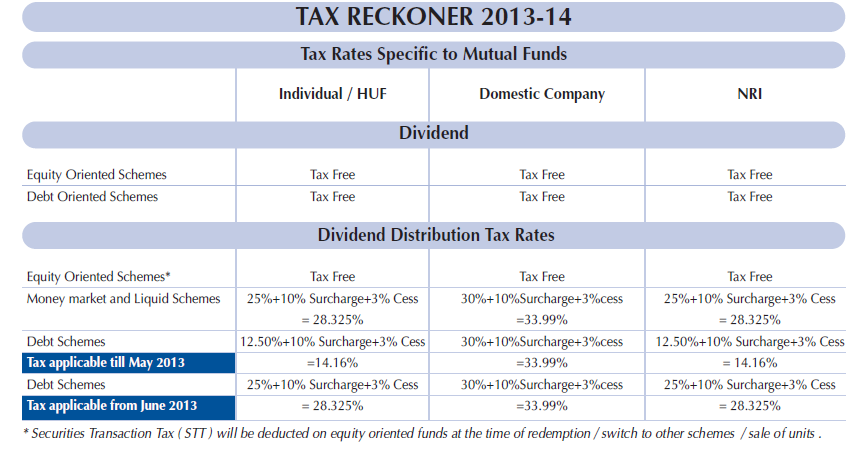
Mutual Fund Tax Rates for FY 2013-14


As per Finance Bill 2013, the DDT applicable for debt funds has increased from 12.5 per cent to 25 per cent for individuals and HUFs.

DDT applicable to any person other than an individual or HUF i.e. a firm, or a company, continues to be 30 per cent.

This new rate is applicable from June 1, 2013 on dividends declared on or after June 1, 2013.


Securities Transaction Tax has been reduced on equity schemes and exchange traded funds to 0.001 per cent for the financial year 2013-14 from June 1, 2013.
Refer this


Tax is deducted at source (TDS) when processing redemptions and switch outs for Non-Resident Indians (NRIs) only. There is no change in the existing TDS rates, but a new surcharge of 10 per cent has been introduced if the income exceeds Rs 1 crore for NRI investors.

New HDFC Mutual Fund Transaction Slip for Purchase, Switch and Redemption

Merger of Reliance Natural Resources Fund into Reliance Vision Fund effective from September 7, 2013


As per the Addendum No 38 released by RMF on 31st Jul 2013, the units held in Reliance Natural Resources Fund (RNRF) have been merged into Reliance Vision Fund (RVF) with effect from September 7, 2013 based on the prevailing NAV of RVF as on the previous day i.e. September 6, 2013 equal to the value of the units held in RNRF.


http://reliancemutual.com/UPLOAD/ARTICLEATTACHMENTS/NoticeNo38RNRFRVF.pdf

Also future transactions related to Systematic Investment Plan (SIP) / Systematic Transfer Plan (STP) / Systematic Withdrawal Plan (SWP) or any other special products registered by you in Reliance Natural Resources Fund will be processed in Reliance Vision Fund on their respective due dates.

 Merger of Reliance Infrastructure Fund  into Reliance Diversified Power Sector Fund effective from September 7, 2013
 
As per the Addendum No 40 released by RMF on 31st Jul 2013, the units held in Reliance Infrastructure Fund (RIF) have been merged into Reliance Diversified Power Sector Fund (RDPSF) with effect from September 7, 2013 based on the prevailing NAV of RDPSF as on the previous day i.e. September 6, 2013 equal to the value of the units held in RIF. 
 

Tax On Debt Mutual Funds In India.....


Short term capital gains on Debt funds
 
Non equity Funds (which holds less than 65% of its expousre in equity)Short term means period of holding is less than a year.
Short Term Capital gains tax is deducted according to individual investor's income tax slab.

Example: Suppose you are getting Rs.25000 gain by selling debt fund within a year and if your annual salary is Rs.5,00,000, then your taxable income will be Rs 5,25,000.

Long Term Capital Gains
Long term capital gains means units are held for more than a year, so tax will be 10% on gains without indexations  or 20% on gains with indexation plus applicable surcharge and education cess.
 
Now how we can calculate long term gains gain with indexation
Example: Indexation helps you to offset your gain with the effect of inflation.

Government will notify the Cost of inflation Index every year.


Table Source: Tax Point India
 
 
In indexation, the investment cost is raised to inflation cost for the period the investment is held. This is done by using a cost inflation index number released by the central tax authorities every year.
Suppose you have invested 2 Lakh in a debt fund in April 2012 and is selling in May 2013 for 2,21,000

 
Your original investment = 2, 00,000

Your Long Term Capital gain is 21,000 (sale price - cost price)
 

Indexed cost:  2, 00,000 x 939/852 = 220422.535
 
Capital Gain after indexation = 2, 21,000 – 220422.535 = 577.465 (sale price- indexed cost)
 
So, in this case, you have to pay 20% tax on the gain of 577.465/- only and not on the gain of 21,000!  Your tax liability is only 115/-. This is the benefit of indexation.
 
If you don’t want to apply indexation, you have to pay 10% tax on the gain of 21,000. Then the tax liability will be 2100/-.
 
 
How does debt mutual funds taxation differ for NRI investors?
If you are an NRI and you invest in an  non equity mutual fund and redeem it, tax will be deducted at source. This is only for NRIs, not for resident individual investors.
 
Short Term Capital Gains
TDS on STCG is applicable at 30% for debt mutual funds.

Long Term Capital Gains
 TDS on LTCG will be applicable at 20%.


Scan this QR code using a bar code scanner on your smart phone to get instant information about us

Scan this QR code using a bar code scanner on your smart phone to get instant information about us
Investing Can be Interesting & Financial Awareness

Popular Posts

Golden Rules for Investing

Golden Rules for Investing