Search This Blog

Revision in the Self Declaration Form (2014-15)


Distributors of mutual funds in India are required to submit the Self-Declaration form every year before the end of the financial year to the RTAs. A Self-Declaration form is all about compliance of circulars issued by AMFI

September 26, 2014 Amfi revised self declaration format (CIR/AR-17/14-15)


On appropriate Letterhead


Date
  • Amfi Registration Number

  • Name of ARN Holder
  • Landline
  • Mobile
  • Email 
To,
CAMS AMFI UNIT,


Sub: Declaration of Self-Certification (DSC): Period / Financial Year 2014-15

"This is to certify that, in the course of my/our business in the distribution of mutual fund products during the period / financial year ended March 31, 2015. I/we have adhered to the Code of Conduct contained in SEBI circular no. SEBI/IMD/CIR No. 8/174648/2009 dated August 27, 2009 and to the requirements as prescribed in SEBI’s circular no. MFD/CIR/20/23230/2002 dated November 28, 2002 and the AMFI circular no. CIR/ARN-09/08-09 dated July 18, 2008 has been adhered to.”

In compliance with SEBI Circular no. SEBI/ IMD/CIR/No.4/168230/09 dated June 30, 2009,  I/ we have disclosed to investors all the commissions (in the form of trail commission or any other mode) payable to me /us for the different competing schemes of various mutual funds from amongst which the scheme was recommended to our investors.

I/ We also certify that I/ we have complied with the Know Your Distributor (KYD) requirements as per AMFI Guidelines.

I/ We further certify that I/ we have adhered to the SEBI and AMFI Guidelines issued from time to time.

I certify that I am a distributor of mutual funds and registered with AMFI and that in my capacity /relationship as a distributor, I may provide investment advise to my clients, incidental to my primary activity of distribution of mutual fund products, which is exempted from registration under Regulation 4 (d) of Securities and Exchange Board of India (Investment Advisors) Regulations 2013. Kindly update this DSC on your records and with all theFund Houses where we are empanelled.

              Regards,


 NAME AND ARN NO
(Authorised Signatory)


Declaration of Self Certification For Mutual Fund Distributors For FY 2013-14


As you all are aware, Distributors are required to submit the Annual Self Certification for the financial year ending 31st Mar 2014 to CAMS at the earliest.


Kindly make note of the following points to ensure that the self certification form submitted by you is in order and the same will not be rejected.

Please use the attach appropriate form prescribed by AMFI (based on the category you belong) and ensure all details are filled(including your ARN code) and the same should be signed.

In the case of corporate entity, the signature should be appended by the Authorized signatory/ ies. 


The Financial year to be mentioned is 2013-14 and the certification is for the financial year ended 31st March 2014. 


Please note that the self certification is to submitted to CAMS and you need not submit multiple forms with other RTA's/AMC's (To Avoid Duplication).

Yes now cams accepts forms for all mutual fund houses.


Kindly arrange to submit the duly filled forms at the earliest to avoid any delay in processing the request and consequential payment of brokerage.


Your Name
(ARN-)
AMFI Registered Mutual Fund Advisor

…………………………………………………………………………………………….................................................

To,
Date: 


…………………………………………

Dear Sirs, 
The Registrar and Transfer Agent of Mutual Funds
(Please tick as applicable)

CAMS     Franklin Templeton  

        Karvy CPL             Deutsche ISPL

Escorts     Sundaram BNP Paribas FSL     

Sub: Declaration of Self-Certification (DSC): Period / Financial Year 2013-14


"This is to certify that, in the course of my/our business in the distribution of mutual fund products during the period / financial year ended March 31, 2014. I/we have adhered to the Code of Conduct contained in SEBI circular no. SEBI/IMD/CIR No. 8/174648/2009 dated August 27, 2009  and to the requirements as prescribed in SEBI’s circular no. MFD/CIR/20/23230/2002 dated November 28, 2002 and the AMFI circular no. CIR/ARN-09/08-09 dated July 18, 2008 has been adhered to.”

In compliance with SEBI Circular no. SEBI/ IMD/CIR/No.4/168230/09 dated June 30, 2009,  I/ we have disclosed to investors all the commissions (in the form of trail commission or any other mode) payable to me /us for the different competing schemes of various mutual funds from amongst which the scheme was recommended to our investors.

I/ We also certify that I/ we have complied with the Know Your Distributor (KYD) requirements as per AMFI Guidelines.

I/ We further certify that I/ we  have adhered to the SEBI and AMFI Guidelines issued from time to time.

Kindly update this DSC on your records and with all the Fund Houses where we are empanelled. 

Kind Regards


(Authorised Signatory)
YourName
ARN-  


* Information is desirable for all  important communication o be disseminated efficiently


All Indian currency notes issued before 2005 will be completely withdrawn from circulation by 31st March 2014.


If your currency notes don’t have a year printed on them, you should get them changed as the Reserve Bank of India (RBI) has announced its plans to withdraw all currency noted issued before 2005.


How to identify Pre 2005 currency notes


The notes printed after 2005 has the year of printing clearly printed in the middle of the bottom row on the backside.


All the notes printed before the year 2005 do not have the year of printing marked on it.

If your bank note has no year of printing on the back, it means the note is printed before 2005 and needs to be exchanged with the bank as per the RBI deadline.


Which currency notes are acceptable


All currency notes printed post 2005 have the year of printing clearly printed in the middle of the bottom row on the backside of the note.

How to Exchange Old Currency Notes

If you have identified your currency notes is printed before 2005, first thing don't panic as per the RBI, all old notes would continue to be completely legal and can be exchanged at any bank after April 1, 2014.


Which currency notes denominations will be withdrawn

At present, currency notes in denominations of Rs 5, Rs 10, Rs 20, Rs 50, Rs 100, Rs 500 and Rs 1,000 are issued. The Withdrawal rule is applicable for all currency notes.


How it works
1. Till 31st march 2014, all currency notes are  acceptable

2. After 31st March 2014, you will be required to approach banks for the exchange of these notes as will completely withdraw from circulation all bank notes issued prior to 2005.

3. These exchange counters will become operation from 1st April 2014. If you have a large amount of old currency notes with you, you may want to exchange them, before 30th June 2014.


4. From July 1, 2014, All exchanges done before 30th June would be unconditional as to exchange more than 10 pieces of Rs.500 and Rs.1,000 notes, non-customers will have to furnish proof of identity and residence to the bank branch in which she/he wants to exchange the notes.


Source:

How to check your Aadhaar status in your mobile - Android application


C. G. Technosoft Pvt. Ltd come up with official application to check your Aadhaar Staus i.e  your aadhaar linking Status with Banks and LPG supply companies.

Link of official application to check your aadhaar card status:


Your ATM Pin is now compulsory on all purchases on debit cards at retail outlets..


As per Reserve Bank of India (RBI) guidelines, from 1 December 2013, all debit card transactions at retail outlets will need to be validated using the existing ATM PIN. The move was introduced to reduce the incidence of frauds in payment systems.


Now every time you swipe your card at a merchant outlet, you will have to enter the personal identification number (PIN) that you use at an automated teller machine (ATM).


Here's how your Debit Card with PIN works

➡Step 1. The merchant swipes/inserts your Debit Card into a Point Of Sale (POS) machine.
➡Step 2. The merchant then enters the transaction amount.
➡Step 3. The POS machine prompts for a PIN to be entered by you.
➡Step 4. You enter your Debit Card ATM PIN in the POS machine to complete the transaction.

Safety tips to keep in mind while transacting using your Debit Card

✔Never share your Debit Card ATM PIN with anyone, including the merchant.

✔You should always insist on entering the PIN yourself.

✔Use your hand or body to shield your PIN from onlookers while you are entering the PIN.

✔Keep your Debit Card in sight during any transaction, especially at restaurants and fuel stations.

✔Remember to take your Debit Card back when the transaction is complete and ensure that it is your Debit Card only

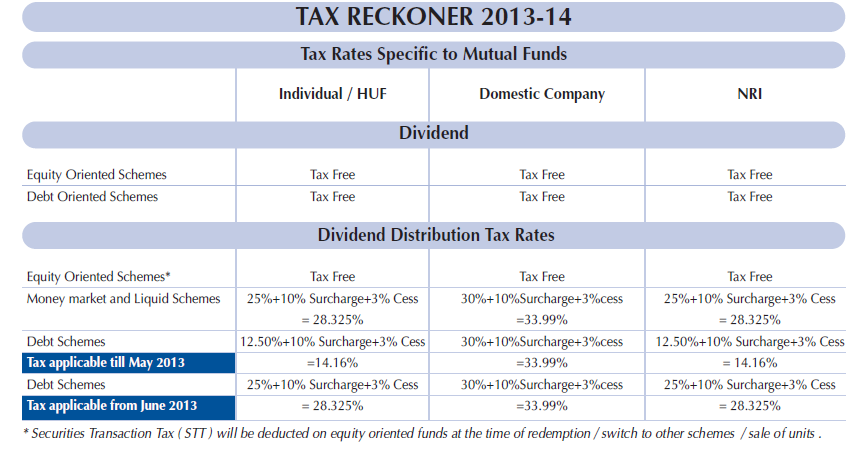
Mutual Fund Tax Rates for FY 2013-14


As per Finance Bill 2013, the DDT applicable for debt funds has increased from 12.5 per cent to 25 per cent for individuals and HUFs.

DDT applicable to any person other than an individual or HUF i.e. a firm, or a company, continues to be 30 per cent.

This new rate is applicable from June 1, 2013 on dividends declared on or after June 1, 2013.


Securities Transaction Tax has been reduced on equity schemes and exchange traded funds to 0.001 per cent for the financial year 2013-14 from June 1, 2013.
Refer this


Tax is deducted at source (TDS) when processing redemptions and switch outs for Non-Resident Indians (NRIs) only. There is no change in the existing TDS rates, but a new surcharge of 10 per cent has been introduced if the income exceeds Rs 1 crore for NRI investors.

New HDFC Mutual Fund Transaction Slip for Purchase, Switch and Redemption

Merger of Reliance Natural Resources Fund into Reliance Vision Fund effective from September 7, 2013


As per the Addendum No 38 released by RMF on 31st Jul 2013, the units held in Reliance Natural Resources Fund (RNRF) have been merged into Reliance Vision Fund (RVF) with effect from September 7, 2013 based on the prevailing NAV of RVF as on the previous day i.e. September 6, 2013 equal to the value of the units held in RNRF.


http://reliancemutual.com/UPLOAD/ARTICLEATTACHMENTS/NoticeNo38RNRFRVF.pdf

Also future transactions related to Systematic Investment Plan (SIP) / Systematic Transfer Plan (STP) / Systematic Withdrawal Plan (SWP) or any other special products registered by you in Reliance Natural Resources Fund will be processed in Reliance Vision Fund on their respective due dates.

 Merger of Reliance Infrastructure Fund  into Reliance Diversified Power Sector Fund effective from September 7, 2013
 
As per the Addendum No 40 released by RMF on 31st Jul 2013, the units held in Reliance Infrastructure Fund (RIF) have been merged into Reliance Diversified Power Sector Fund (RDPSF) with effect from September 7, 2013 based on the prevailing NAV of RDPSF as on the previous day i.e. September 6, 2013 equal to the value of the units held in RIF. 
 

Tax On Debt Mutual Funds In India.....


Short term capital gains on Debt funds
 
Non equity Funds (which holds less than 65% of its expousre in equity)Short term means period of holding is less than a year.
Short Term Capital gains tax is deducted according to individual investor's income tax slab.

Example: Suppose you are getting Rs.25000 gain by selling debt fund within a year and if your annual salary is Rs.5,00,000, then your taxable income will be Rs 5,25,000.

Long Term Capital Gains
Long term capital gains means units are held for more than a year, so tax will be 10% on gains without indexations  or 20% on gains with indexation plus applicable surcharge and education cess.
 
Now how we can calculate long term gains gain with indexation
Example: Indexation helps you to offset your gain with the effect of inflation.

Government will notify the Cost of inflation Index every year.


Table Source: Tax Point India
 
 
In indexation, the investment cost is raised to inflation cost for the period the investment is held. This is done by using a cost inflation index number released by the central tax authorities every year.
Suppose you have invested 2 Lakh in a debt fund in April 2012 and is selling in May 2013 for 2,21,000

 
Your original investment = 2, 00,000

Your Long Term Capital gain is 21,000 (sale price - cost price)
 

Indexed cost:  2, 00,000 x 939/852 = 220422.535
 
Capital Gain after indexation = 2, 21,000 – 220422.535 = 577.465 (sale price- indexed cost)
 
So, in this case, you have to pay 20% tax on the gain of 577.465/- only and not on the gain of 21,000!  Your tax liability is only 115/-. This is the benefit of indexation.
 
If you don’t want to apply indexation, you have to pay 10% tax on the gain of 21,000. Then the tax liability will be 2100/-.
 
 
How does debt mutual funds taxation differ for NRI investors?
If you are an NRI and you invest in an  non equity mutual fund and redeem it, tax will be deducted at source. This is only for NRIs, not for resident individual investors.
 
Short Term Capital Gains
TDS on STCG is applicable at 30% for debt mutual funds.

Long Term Capital Gains
 TDS on LTCG will be applicable at 20%.


Securities Transaction Tax (STT) paid on Mutual Fund Units in India - FY 2013-14


Securities Transaction Tax
Equity Oriented Fund
Sale of a unit of an equity-oriented mutual fund0.001%
Purchase of a unit of an equity-oriented mutual fund where the transaction is entered into a recognized stock exchange and the contract for sale is settled by the actual deliveryNIL
Sale of a unit of an equity-oriented mutual fund the where transaction is entered into a recognized stock exchange and the contract for sale is settled by the actual delivery0.001%

Other than Equity-oriented Fund – Exempt from Securities Transaction Tax
Mutual Funds will also pay securities transaction tax wherever applicable on the securities bought/sold.


Securities Transaction Tax has been reduced on equity schemes and exchange traded funds to 0.001 per cent for the financial year 2013-14 from June 1, 2013.

There are three areas where the STT would come into play.

1. Buying Mutual fund units from stock exchange - units going into individual's demat account
Earlier it was 0.1% now this has been abolished (w.e.f June 1, 2013) 

2. Selling Mutual Fund Units on the stock exchanges
Earlier it was 0.1% now current rate is 0.001% (w.e.f June 1, 2013)

3. Selling Mutual Fund Units directly to fund house.
 Earlier it was 0.25% now current rate is 0.001% (w.e.f June 1, 2013). This means on a transaction of Rs 1 lakh the tax will be just Re 1. 


How to get Mutual Fund Portfolio Valuation Statement??


Mutual Fund Portfolio Valuation Statement is available in Karvy as well as Cams.


How to get that?

I. From cams


1.Visit camsonline mailback services for Investors
2. click Portfolio Valuation Statement.
3. Submit your registered email address. If you have not provided an email address in your mutual fund application fom this request can't be responded.


II. From Karvy

Visit here : Karvy Portfolio Valuation for Investors by email
or  Portfolio Valuation By PAN


 Also refer:


1. How to update Pan in all mutual fund schemes with one request


2.  How to change email address in mutual funds in India


Important Information on Employee Unique Identification Number (EUIN)..


EUIN is a unique number allotted to employees of distributors involved in selling mutual fund products. This number is being allotted pursuant to AMFI best practices circular no. 33 dated December 31, 2012 as amended vide AMFI best practice circular no. 37 dated March 28, 2013.


EUIN will assist in identifying the employee who sold the mutual fund product and address issues of mis-selling even if he/she leaves the employment of the distributor.
While investing in any mutual fund scheme, please specify the EUIN of the employee / distributor who advised you on the investment. If you have not sought any investment advice but merely executed the transaction through a distributor, please sign the declaration to this effect. Below is the relevant portion of the application form which you need to fill.


Investors shall ensure that the application form, if routed through a Distributor shall have a valid ARN code, Sub broker ARN code, and EUIN.

 Investors are further requested to use only those application forms/ transaction forms which have spaces for the Sub broker ARN code and the EUIN.


Is the dividend re-investment in a Tax Saver fund also subject to a lock-in period of 3 years?


Is the dividend re-investment in a Tax Saver fund also subject to a lock-in period of 3 years? Also post completion of the 3 year lock-in period, can the non-dividend part be redeemed?

 Any investment made into an Equity Linked Saving Scheme (ELSS) is subject to a lock-in period of 3 years, same holds even for dividends from ELSS which is re-invested if the investor has chosen the dividend re-investment option. 


The implication for the investor is that some portion of his investment will always be locked-in because dividend declared is re-invested and will attract a three year lock-in.

However, any portion of the investment, whether originally made or as a result of dividend re-invested, which has completed the lock-in period of three years, can be redeemed by the investor.

 Alternatively, investors may choose the growth option while investing, or if opted for dividend reinvestment and want to make changes, he can do so by making changes in dividend option, i.e from dividend reinvestment to dividend payout.

Also refer:

Tax Treatment for Equity Linked Savings Scheme (ELSS)

Tax Treatment of Public Provident Fund (PPF)  


Capital Gains Tax on Sale of Mutual Fund Units!


Investors have to pay short-term and long-term capital gains on mutual fund investments. 

When units are held over a period of one year, investors pay long-term capital gains tax on debt funds. In case of equity mutual funds, there is no long-term capital gains tax. This means if you hold units of equity fund for a period of more than 12 months, you can avoid the short-term capital gains tax.

For investments sold within one year, you pay 16.995% (15% + cess) short-term capital gains tax.


Short Term Capital Gains  


Long Term Capital Gains

Scan this QR code using a bar code scanner on your smart phone to get instant information about us

Scan this QR code using a bar code scanner on your smart phone to get instant information about us
Investing Can be Interesting & Financial Awareness

Popular Posts

Golden Rules for Investing

Golden Rules for Investing