Search This Blog

All Indian currency notes issued before 2005 will be completely withdrawn from circulation by 31st March 2014.


If your currency notes don’t have a year printed on them, you should get them changed as the Reserve Bank of India (RBI) has announced its plans to withdraw all currency noted issued before 2005.


How to identify Pre 2005 currency notes


The notes printed after 2005 has the year of printing clearly printed in the middle of the bottom row on the backside.


All the notes printed before the year 2005 do not have the year of printing marked on it.

If your bank note has no year of printing on the back, it means the note is printed before 2005 and needs to be exchanged with the bank as per the RBI deadline.


Which currency notes are acceptable


All currency notes printed post 2005 have the year of printing clearly printed in the middle of the bottom row on the backside of the note.

How to Exchange Old Currency Notes

If you have identified your currency notes is printed before 2005, first thing don't panic as per the RBI, all old notes would continue to be completely legal and can be exchanged at any bank after April 1, 2014.


Which currency notes denominations will be withdrawn

At present, currency notes in denominations of Rs 5, Rs 10, Rs 20, Rs 50, Rs 100, Rs 500 and Rs 1,000 are issued. The Withdrawal rule is applicable for all currency notes.


How it works
1. Till 31st march 2014, all currency notes are  acceptable

2. After 31st March 2014, you will be required to approach banks for the exchange of these notes as will completely withdraw from circulation all bank notes issued prior to 2005.

3. These exchange counters will become operation from 1st April 2014. If you have a large amount of old currency notes with you, you may want to exchange them, before 30th June 2014.


4. From July 1, 2014, All exchanges done before 30th June would be unconditional as to exchange more than 10 pieces of Rs.500 and Rs.1,000 notes, non-customers will have to furnish proof of identity and residence to the bank branch in which she/he wants to exchange the notes.


Source:

How to check your Aadhaar status in your mobile - Android application


C. G. Technosoft Pvt. Ltd come up with official application to check your Aadhaar Staus i.e  your aadhaar linking Status with Banks and LPG supply companies.

Link of official application to check your aadhaar card status:


Your ATM Pin is now compulsory on all purchases on debit cards at retail outlets..


As per Reserve Bank of India (RBI) guidelines, from 1 December 2013, all debit card transactions at retail outlets will need to be validated using the existing ATM PIN. The move was introduced to reduce the incidence of frauds in payment systems.


Now every time you swipe your card at a merchant outlet, you will have to enter the personal identification number (PIN) that you use at an automated teller machine (ATM).


Here's how your Debit Card with PIN works

➡Step 1. The merchant swipes/inserts your Debit Card into a Point Of Sale (POS) machine.
➡Step 2. The merchant then enters the transaction amount.
➡Step 3. The POS machine prompts for a PIN to be entered by you.
➡Step 4. You enter your Debit Card ATM PIN in the POS machine to complete the transaction.

Safety tips to keep in mind while transacting using your Debit Card

✔Never share your Debit Card ATM PIN with anyone, including the merchant.

✔You should always insist on entering the PIN yourself.

✔Use your hand or body to shield your PIN from onlookers while you are entering the PIN.

✔Keep your Debit Card in sight during any transaction, especially at restaurants and fuel stations.

✔Remember to take your Debit Card back when the transaction is complete and ensure that it is your Debit Card only

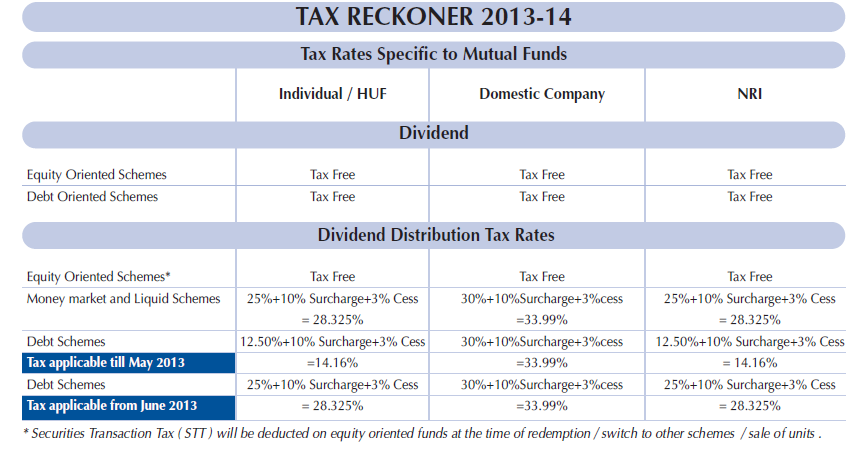
Mutual Fund Tax Rates for FY 2013-14


As per Finance Bill 2013, the DDT applicable for debt funds has increased from 12.5 per cent to 25 per cent for individuals and HUFs.

DDT applicable to any person other than an individual or HUF i.e. a firm, or a company, continues to be 30 per cent.

This new rate is applicable from June 1, 2013 on dividends declared on or after June 1, 2013.


Securities Transaction Tax has been reduced on equity schemes and exchange traded funds to 0.001 per cent for the financial year 2013-14 from June 1, 2013.
Refer this


Tax is deducted at source (TDS) when processing redemptions and switch outs for Non-Resident Indians (NRIs) only. There is no change in the existing TDS rates, but a new surcharge of 10 per cent has been introduced if the income exceeds Rs 1 crore for NRI investors.

Scan this QR code using a bar code scanner on your smart phone to get instant information about us

Scan this QR code using a bar code scanner on your smart phone to get instant information about us
Investing Can be Interesting & Financial Awareness

Popular Posts

Golden Rules for Investing

Golden Rules for Investing